
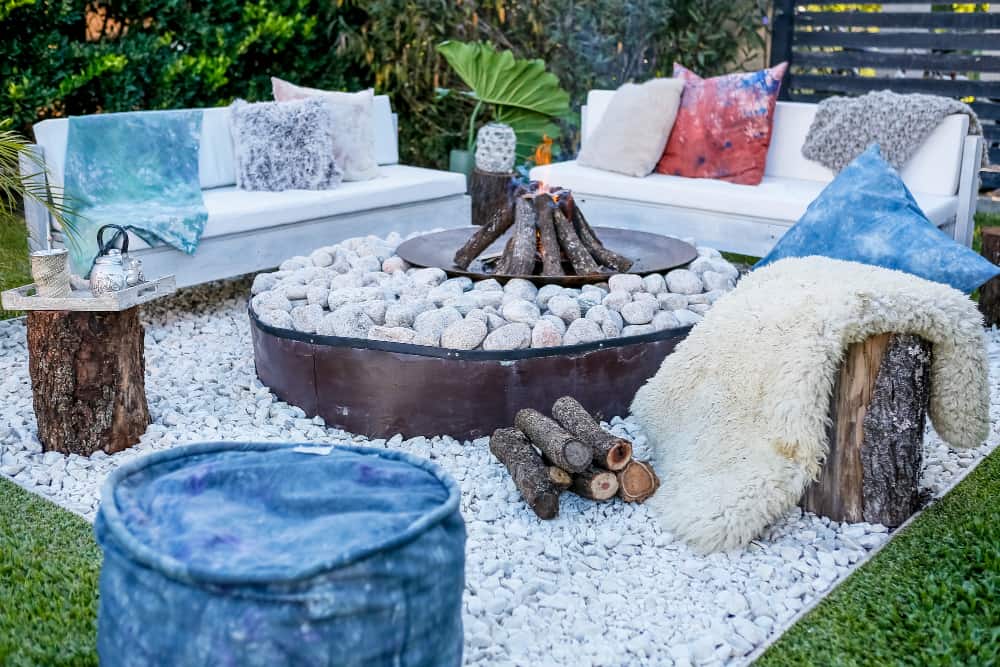
You finally bought the gas fire pit. The burner’s installed, the gas line is hooked up, and you’re standing there holding an empty steel bowl wondering what’s supposed to fill it. Nobody warned you this was a decision. Now there are three options staring back at you online, all promising to be the best, and none of them explaining how they actually differ.
So let’s clear it up. Three media dominate gas and propane fire features: fire glass, lava rock, and smooth fire stones. They’re not interchangeable, and the right pick depends on your burner, your look, and how much fuss you’re willing to tolerate.
What actually goes in a gas burner?
First, the rule that keeps you safe. Whatever you drop in there has to be heat-rated and, just as important, fully dry inside. Regular landscaping pebbles, river rocks from the yard, anything porous? Off the table. Trapped moisture inside a non-rated stone turns to steam under flame and the rock can crack or pop. People learn this the hard way every summer.
Heat-rated media is engineered or selected not to hold water and not to shatter at temperature. A good gas burner runs hot, some up to 120,000 BTUs, and the filler has to shrug that off for years. That’s the whole job. This is exactly why specialised ranges of fire stones for outdoor spaces are sorted and rated specifically for flame, vetted to stay dry and survive the heat so you’re not gambling on a random bag. Everything below assumes you’re choosing among products built for it, not whatever happens to look nice in the driveway.
Why pick fire glass?
Fire glass is the flashy one. Tempered, tumbled chunks that glitter when the flame hits them, and they come in colours real stone can’t fake, cobalt, amber, that reflective black mirror look.
The upside is pure aesthetics. On a modern patio with clean lines, glass reads sharp and contemporary. The downside is it shows soot. Propane and natural gas both leave a faint film over time, and on a bright blue glass it’s visible, so you’ll be rinsing it more than you’d like. Glass also tends to cost more per coverage than stone. If your fire pit is the centrepiece of a sleek outdoor lounge and you don’t mind upkeep, glass earns its spot.
Why pick lava rock?
Lava rock is the workhorse. Porous, rugged, dark, and cheap. It’s been the default fill for decades because it’s nearly indestructible and great at one specific thing: distributing heat and hiding the burner cleanly.
Here’s the catch with lava rock. Because it’s porous by nature, sourcing matters, it needs to be properly dried and rated, or you’re back to the popping problem. It also looks rough and volcanic, which is exactly what some people want and exactly what others are trying to avoid. For a rustic setup, a cabin firepit, a no-fuss build, lava rock is honest and effective. For a polished patio, it can look like filler.
Where do smooth fire stones fit?
This is the middle path most people overlook. Smooth, flat, rounded fire stones give you the natural look of real rock without the jagged volcanic texture, and without the high-maintenance shine of glass. They come in matte and polished finishes across blacks, slate greys, off-whites, and warm ivory-tan tones, so they coordinate with stone you might already have elsewhere in the yard.
This is the sweet spot for anyone matching a fire feature to existing hardscape. A curated set of smooth fire stones covers gas, propane, and ethanol installations, indoor or outdoor, and the rounded shapes sit naturally in the burner instead of looking like a bag of driveway gravel. Suppliers that specialise in this carry several finishes vetted for fire use, which solves the dryness-and-rating problem for you. Coverage works out to roughly one square foot per 20-pound bag at two inches deep, so it’s easy to estimate before you order.
So which one wins?
None of them, universally, and anyone telling you otherwise is selling one product. It comes down to three questions.
What’s your style? Modern and bold leans glass. Natural and understated leans smooth stone. Rugged and rustic leans lava rock.
How much maintenance can you stand? Glass demands the most rinsing. Stone and lava rock are lower-fuss, with stone edging out lava for showing less grime on lighter colours.
What’s nearby? If you’ve got stone pathways, a gravel border, or natural-toned hardscape already, smooth fire stones tie the whole space together in a way glass and raw lava simply can’t.
What about how long it lasts?
This is the question that should settle a lot of arguments and rarely comes up. All three rated options outlive the burner if you treat them right. Fire glass can cloud or pick up surface scorching if the gas isn’t burning clean, but it doesn’t degrade structurally. Lava rock breaks down slowest of all, though it traps soot deep in its pores where you can’t rinse it, so it dulls over years. Smooth stones land in between, and because they’re non-porous on the surface, a quick wipe brings the colour back.
The real lifespan killer isn’t the media at all. It’s moisture. Any of these will eventually pop or spall if water gets trapped and then meets flame, which is why a cover in the off-season matters more than the brand on the bag. Keep the fill dry, keep the burner clean, and you’re replacing the pit before you replace the stones.
A couple of things people forget
Depth matters. You want enough media to fully conceal the burner and pan, usually a couple of inches, but not so much that you bury the ports and choke the flame. Check your burner’s clearance spec before you pour.
Buy enough the first time. Running short halfway through a fill and waiting on a second order is the classic rookie move. Measure the bowl’s surface area, match it to the bag coverage, and round up.
And don’t overthink the colour in isolation. Pull it next to your patio stone, your furniture, your siding. Fire features read differently lit at night than they do in a product photo, so a small sample saved from a bad full-size order is worth the few dollars it costs.
The honest takeaway
There’s no trophy for picking the “best” fire media, only the one that fits your burner, your eye, and your tolerance for cleaning. Glass for drama, lava for grit, smooth stones for natural balance. Most people who agonise over this end up happiest with the option that matches what’s already in their yard rather than the one that looked boldest on a screen. Hold a sample, light it once, and you’ll know within an evening which one belongs in your bowl.